
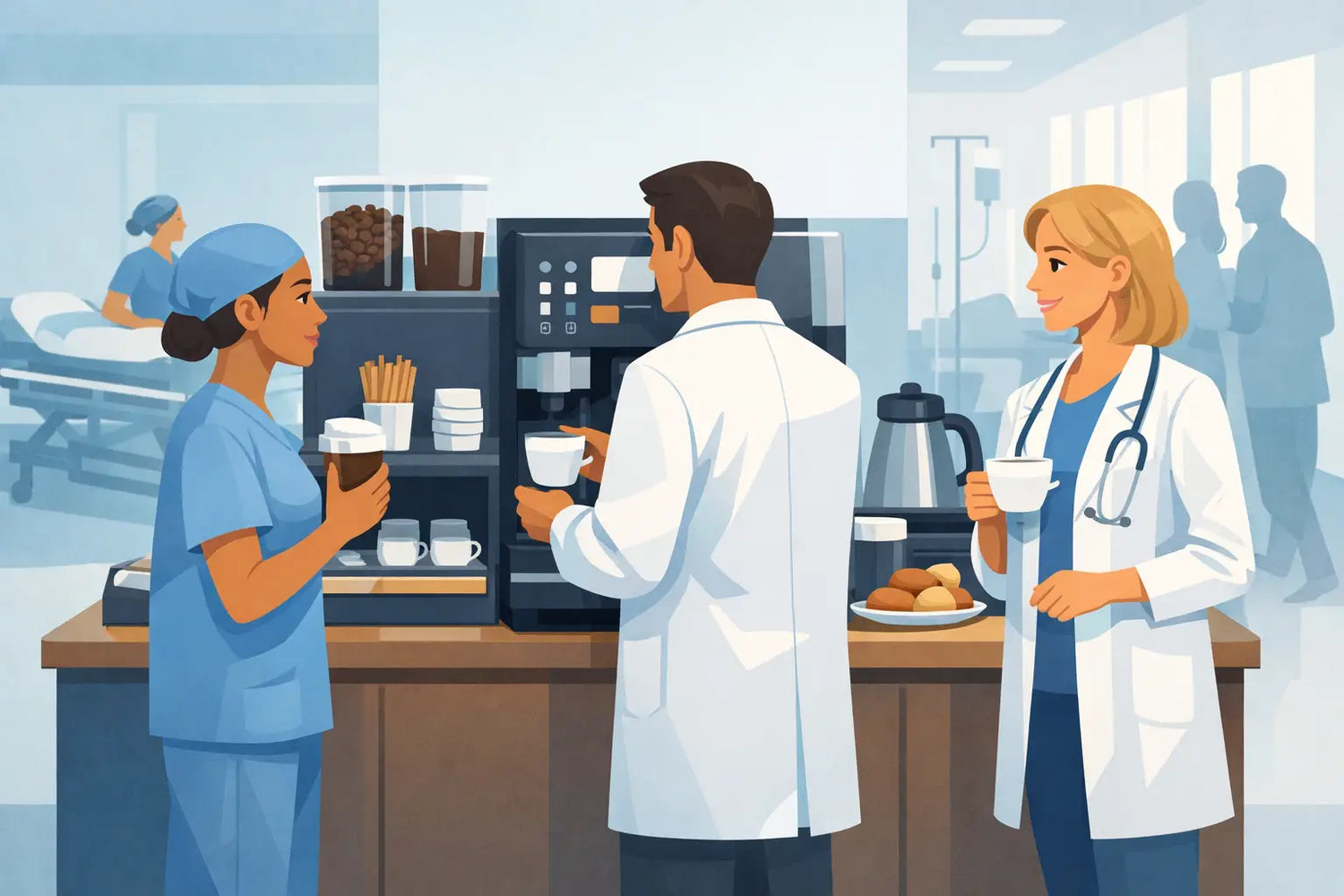
At 6:45 a.m., a nurse may have only minutes between handoff and the next patient need. At 2:00 a.m., an environmental services team member may need the same dependable reset. A coffee solution for hospital staff has to work around that reality: it must be fast, consistently good, easy to maintain, and available across the shifts that keep a facility moving.
For hospital administrators, facilities leaders, and people teams, coffee is not a small perk when it is the only amenity employees can access during a short break. The right setup supports staff experience without creating another supply closet to manage, another vendor to chase, or another piece of equipment waiting on repair.
What Hospital Staff Need From Coffee Service
Hospital beverage service is different from a typical office pantry. Schedules are uneven, teams are large, and demand may surge at shift changes, during overnight coverage, or in a waiting-area rush. Employees also work in distinct zones, from clinical floors and administrative offices to security desks, staff lounges, and outpatient centers.
That makes convenience a performance issue. If staff must walk across a campus, wait behind a long line, or settle for stale drip coffee, the program is not serving the people who rely on it. A strong coffee setup puts quality drinks near the teams using them while keeping day-to-day administration simple.
Freshness matters, too. Whole-bean coffee ground on demand gives employees a noticeably better cup than coffee that has been sitting in a pot. It also gives a facility the ability to offer familiar choices, such as espresso, cappuccino, latte, Americano, and hot chocolate, from one professional machine. When drinks are prepared in under 60 seconds, staff can use their break rather than spend it waiting.
Build a Coffee Solution for Hospital Staff Around Shifts
The best approach is rarely one machine in one central break room. It depends on the size of the campus, employee count, visitor traffic, existing food service, and where staff actually take breaks. A smaller outpatient clinic may need one high-capacity unit in a staff area. A larger hospital may benefit from several strategically placed machines that reduce travel time and prevent bottlenecks.
Start by mapping demand, not just floor plans. Look at headcount by department and shift, identify high-traffic staff spaces, and account for areas that operate 24 hours a day. A coffee station used by 50 daytime administrative employees has very different requirements from one serving nursing, security, and support teams around the clock.
Placement should respect hospital protocols. Coffee equipment belongs in approved nonclinical locations with appropriate access to power, water, drainage, and routine cleaning. Facilities teams should confirm local requirements and internal infection-prevention practices before installation. The goal is a convenient employee amenity that fits cleanly into the facility's operating standards.
Prioritize speed without sacrificing drink quality
Fast does not have to mean basic. Fully automatic bean-to-cup systems can grind premium Colombian whole beans and prepare customized drinks at the touch of a screen. That means a staff member can select a bold coffee before rounds, while another chooses a milk-based drink during an afternoon break.
This is where traditional coffee pots often fall short. They may be inexpensive to purchase, but they demand repeated brewing, cleaning, filter and coffee ordering, and constant attention to freshness. Pods can offer variety, yet they introduce inventory complexity and significant single-use waste. A capsule-free bean-to-cup machine offers a more polished experience with fewer individual components to stock and discard.
Match capacity to the real rush
A machine that performs well at 10 cups per hour may struggle when 30 employees arrive at a staff lounge within 15 minutes. Capacity planning should consider peak use, not average daily consumption. High-volume systems, multiple machines, or separate stations in key areas can keep lines short when shifts overlap.
There is a trade-off. More equipment can improve access, but it also requires a service partner capable of maintaining every location. Choosing fewer machines simply to reduce the initial footprint can create frustration if employees cannot get a drink when they need one. The right design balances access, volume, available space, and support coverage.
Make Service and Maintenance Part of the Program
Hospital teams should not be responsible for troubleshooting grinders, remembering cleaning cycles, or tracking whether milk powder, cups, sweeteners, and beans are running low. In a busy facility, those tasks often get passed between departments until they become an avoidable service problem.
A managed program changes the equation. Instead of treating the coffee machine as a standalone purchase, it combines equipment, premium beans, consumables, machine care, and maintenance into one coordinated service. When a machine needs attention, there is a defined path to resolution. When consumption changes, the program can be adjusted rather than left to guesswork.
That reliability is especially valuable in hospitals, where amenity downtime is more visible than it might seem. An out-of-service machine at the beginning of a night shift is not merely inconvenient. It tells employees that a promised break-room resource cannot be counted on. Consistent upkeep protects the experience as much as the equipment.
For facilities leaders, the financial model matters as well. A pay-per-cup structure can offer clearer cost control than buying equipment, ordering supplies from multiple sources, and absorbing surprise repair costs. With no rental fee and included maintenance, leaders can focus on usage and employee experience rather than managing hidden operational work.
Extend the Break Room Beyond Coffee
Coffee may bring people to the station, but hydration makes it a more complete staff amenity. Water and ice coolers provide a dependable alternative to bottled beverages, while flavored-water systems can give teams a refreshing option without the storage burden of cans and cases.
This is particularly useful where space is tight. Break rooms and staff lounges often have limited storage, and the steady delivery of bottled drinks can create clutter, recycling volume, and extra receiving work. A thoughtfully designed hydration station helps reduce those friction points while giving employees more choices throughout the day.
The best combination depends on the setting. A clinical support lounge may need simple chilled water and coffee. A large administrative or employee commons may benefit from a broader beverage station with sparkling and flavored water options. The common goal is straightforward: make a better break easier to take.
Measure the Experience, Not Just the Cups
Usage data can help a hospital improve its beverage program over time. High cup volume at one station may indicate that another department needs better access. A recurring rush may point to a capacity issue. Low usage might mean the machine is poorly located, the drink menu does not match preferences, or employees do not know the amenity is available.
Feedback matters alongside volume. Ask staff whether drinks are fast enough, whether options are useful, and whether the station is consistently clean and stocked. The answers reveal more than a satisfaction score. They show whether the program is supporting real work patterns.
For hospitals in Miami, Orlando, Tampa, and Raleigh, local service coverage can also make a practical difference. A beverage partner that understands the area and can respond reliably helps reduce the risk of extended downtime across a multi-shift operation.
The Coffee Corp designs managed coffee and hydration programs around each location's space and consumption needs, pairing professional bean-to-cup machines with ongoing supplies and maintenance. That approach keeps the focus where it belongs: giving hospital staff a premium, dependable break without adding work to the teams already supporting patient care.
A well-placed cup of freshly ground coffee will not solve every demanding shift. It can, however, give the people carrying that shift a reliable moment of comfort, energy, and choice - and that is a workplace investment employees notice every day.


Leave a comment
This site is protected by hCaptcha and the hCaptcha Privacy Policy and Terms of Service apply.