
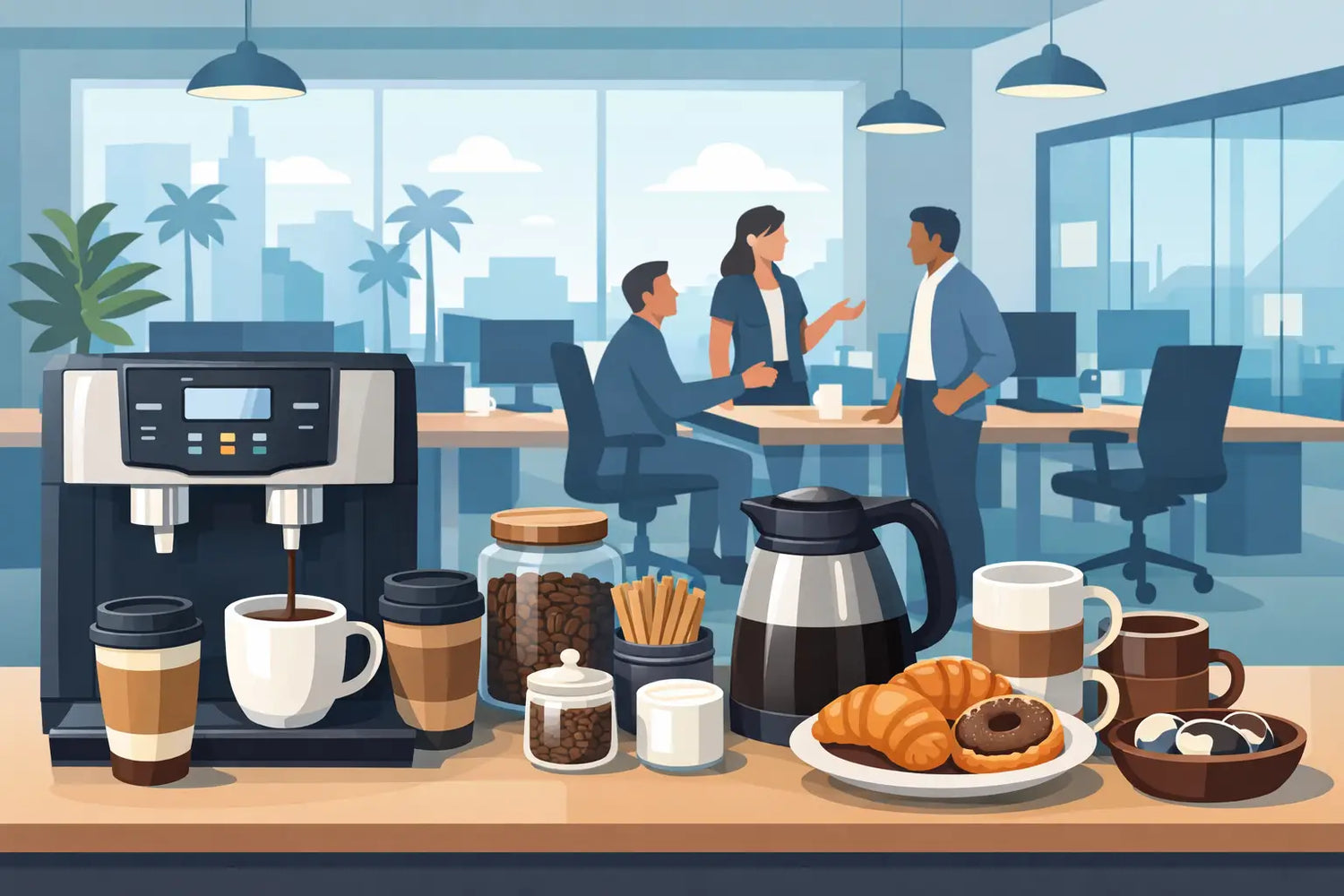
The break room tells people what kind of workplace they have joined. A countertop machine that makes a fast, consistently good drink says employees and guests are worth the extra consideration. An office coffee setup Orlando teams actually use should do more than dispense caffeine. It should remove a daily friction point, support productive conversations, and give visitors a polished first impression without creating another supply-management job for your staff.
For Orlando offices, coworking spaces, medical facilities, residential buildings, and dealerships, the right answer is rarely the cheapest brewer on a shelf. It is a beverage program designed around real demand: how many people are on-site, what they drink, where the equipment will live, and who will keep it running.
What an office coffee setup in Orlando needs to deliver
Great workplace coffee has to perform under ordinary pressure. That means the morning rush, a client arriving early for a meeting, an afternoon team reset, and the occasional day when the office is unexpectedly full. If employees need to wait in line, refill the machine, hunt for milk, or settle for a drink they do not enjoy, the amenity quickly loses its value.
A strong setup balances four priorities: drink quality, speed, convenience, and dependable service. The trade-offs matter. A basic drip brewer may have a lower upfront cost, but it can produce inconsistent coffee, require frequent attention, and leave limited choices for employees who want espresso-based drinks. Single-serve pod systems offer variety, yet generate ongoing capsule waste and can make supply costs harder to predict.
A professional bean-to-cup system takes a different approach. It grinds whole beans for each drink, prepares customized coffee in under 60 seconds, and gives people the experience of a café without sending them off-site. For many workplaces, that combination is what turns coffee from a break-room necessity into a daily workplace benefit.
Start with consumption, not the machine
The best equipment choice begins with a practical question: how many cups will your location serve each day? A 20-person professional office has different needs than a busy dealership lounge or a coworking floor with hundreds of members moving through the space.
Look beyond headcount. Consider the number of guests, meeting frequency, shift schedules, and whether employees already leave the property for coffee. A company with 50 employees may consume far more drinks than a company with 100 if its people work in the office five days a week, host clients regularly, and value barista-style beverages.
It also helps to consider peak traffic. A machine may handle the daily total comfortably but still create a bottleneck if most employees arrive within the same 30-minute window. In higher-volume settings, the right configuration may include more than one machine or a placement strategy that separates employee traffic from guest service.
Match drink options to your workplace
Variety should feel useful, not excessive. Fresh coffee, espresso, cappuccino, latte, and hot chocolate cover the preferences of many teams. Some locations benefit from decaf, dairy alternatives, or separate stations for different departments or visitor areas.
The goal is not to build a coffeehouse menu. It is to make the drinks people want easy to get. When a team can personalize a quality beverage with a few taps, they are more likely to use the amenity and less likely to spend time and money leaving the building.
Choose fresh beans over a cabinet full of pods
Coffee quality starts before the button is pressed. Whole beans ground on demand preserve more of the aroma and flavor that make a cup satisfying. For workplace decision-makers, that quality difference has a practical effect: employees notice it.
Premium Colombian whole beans provide a familiar, balanced profile that works well across black coffee and milk-based beverages. When paired with a fully automatic professional machine, the process stays simple for the person using it. There is no measuring, tamping, or cleanup expected from employees. They select their drink, and the system handles the preparation.
Capsule-free systems also reduce visible waste. In a busy office, spent pods add up quickly in trash bins and recycling streams that may not accept them. Bean-to-cup equipment produces coffee grounds instead, helping workplaces offer a premium drink experience with fewer disposable capsules in the mix.
There are cases where pods can make sense, particularly in very small offices with occasional use. But once demand rises, whole-bean equipment usually provides a stronger balance of quality, speed, waste reduction, and per-cup consistency.
Design the station around the space people have
An office coffee setup is not just a machine selection. It is a space decision. The station should be easy to find, easy to use, and positioned so it supports the flow of the workplace rather than interrupting it.
In an office, the kitchen or collaboration area is often the natural home for coffee because it encourages informal conversation. In a medical office, a staff-only location may need to remain separate from a patient-facing beverage area. At a dealership, placing fresh coffee near the customer lounge can improve the waiting experience while giving sales teams an easy hospitality tool.
Before installation, consider counter depth, power access, water availability, drainage requirements, and room for cups, stirrers, and ingredients. A compact counter may call for a smaller system, while a high-traffic café-style zone can support a more prominent setup. Good planning prevents an expensive machine from becoming a crowded, inconvenient corner of the break room.
Appearance matters, too. Modern equipment with a clean, professional finish contributes to the workplace experience. It signals that the company has invested in the details, whether the person using it is a candidate interviewing for a role or a customer waiting for an appointment.
Make service part of the coffee plan
Equipment only creates value when it is working, stocked, and clean. This is where many self-managed coffee programs fall short. Someone has to watch inventory, order beans and milk, address cleaning needs, troubleshoot errors, and arrange repairs. That responsibility often lands with an office manager or executive assistant who already has a full workload.
A managed pay-per-cup program changes that equation. Rather than paying rental fees and managing a separate stream of supply orders, workplaces can receive the machine, premium beans, consumables, machine care, and maintenance as part of one service model. Costs track beverage usage, which gives leaders a clearer way to manage the amenity.
Service coverage is especially valuable when downtime affects more than employee convenience. In a client-facing lobby, hospitality should not disappear because a machine needs attention. In a large office, a consistently maintained system helps avoid the familiar cycle of empty hoppers, out-of-service signs, and last-minute store runs.
The Coffee Corp has installed more than 2,000 machines and serves 40,000 daily cups, bringing the operational experience needed to plan for both everyday use and high-demand settings. For a workplace team, that means less time managing coffee and more confidence that the station will be ready when people need it.
Pair coffee with smarter hydration
Coffee gets attention, but hydration is part of the same employee and guest experience. Bottled water deliveries can consume storage space, create restocking work, and leave a steady stream of plastic bottles and cans behind. A workplace that invests in better coffee can make an even stronger impression by improving its water offering at the same time.
Filtered water and ice coolers provide a reliable everyday option for offices and shared spaces. Bevi flavored-water solutions add still or sparkling water with customizable flavor choices, offering a more engaging alternative to packaged drinks. This can be particularly effective in Orlando, where heat and active commutes make accessible hydration a meaningful workplace benefit.
The right mix depends on the location. A compact office may need one water cooler and a coffee machine. A high-traffic coworking facility may benefit from multiple hydration points and a dedicated coffee area. Planning both services together also simplifies vendor coordination and gives the workplace a more complete beverage strategy.
Measure success beyond cups served
Usage matters, but it is not the only sign of a successful program. Listen for fewer complaints about stale coffee, fewer supply requests from staff, and fewer off-site coffee runs during the workday. Notice whether guests are offered a drink more naturally and whether the break area becomes a place where people actually pause and connect.
A quality coffee setup can support retention, culture, productivity, and hospitality, but it should also fit your operating reality. The best program is one your team does not have to think about constantly. It delivers fresh drinks, stays stocked, looks professional, and adapts as your workplace changes.
If your current coffee station creates more chores than compliments, start with a simple site assessment: how many people you serve, what they drink, where they gather, and what your team is tired of managing. That is the foundation for a beverage experience people will look forward to using every day.



Leave a comment
This site is protected by hCaptcha and the hCaptcha Privacy Policy and Terms of Service apply.