
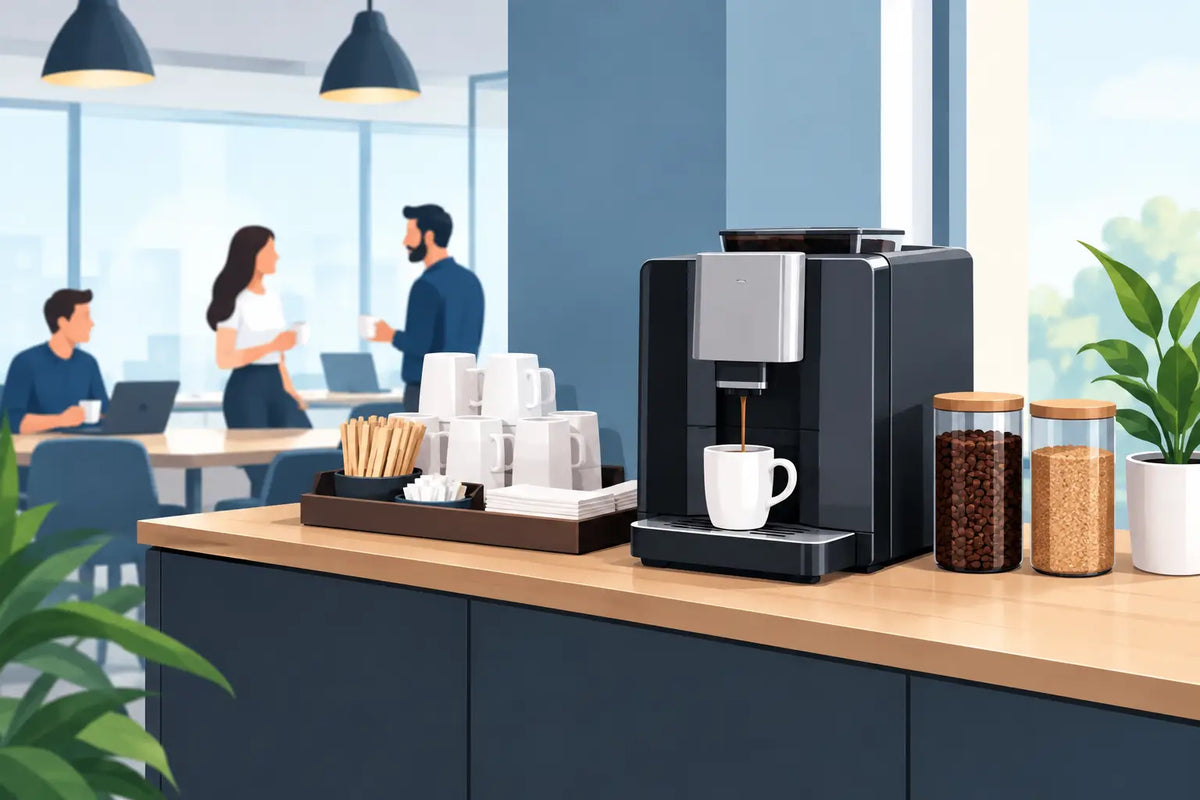
The coffee station tells employees and visitors what kind of workplace they have entered before the first meeting starts. A machine that is empty, slow, or surrounded by discarded pods sends one message. Freshly ground coffee available in seconds sends another. To plan office coffee service well, treat it as an everyday workplace experience, not a breakroom purchase.
The right program should fit how people actually move through your space, what they want to drink, and how much time your team can devote to managing supplies and equipment. For most offices, the goal is straightforward: give people a better cup without giving facilities, operations, or office managers another recurring problem to solve.
Start With Consumption, Not Machine Features
Coffee equipment should follow demand. A compact office with 15 people and a headquarters with 150 people may both want premium coffee, but they need very different throughput, capacity, and service plans. Choosing based on a single impressive feature can lead to a machine that creates a line every morning or one that is unnecessarily large for the space.
Begin by looking at the people who will use the station each day. Include full-time employees, hybrid staff on peak office days, regular guests, clients, vendors, and shared-space users. Then consider when demand happens. Many workplaces see intense traffic from 8:00 to 10:00 a.m., another rush after lunch, and a steady stream of guest beverages throughout the day.
A useful planning estimate is not simply headcount. It is cups per person per day, adjusted for your busiest days. A client-facing dealership, medical facility, or coworking space may serve significantly more beverages per person than a traditional back-office environment. Planning for the average Tuesday may leave you short on the day your office is full, interviews are scheduled, or a tenant event is underway.
This is also the moment to decide what counts as a beverage in your program. Employees may want espresso, coffee, cappuccino, latte, hot chocolate, tea, or hot water. Guests may expect a polished coffee option as part of the welcome experience. If hydration is part of the same destination, sparkling and flavored water can reduce bottled beverage clutter while giving people more reasons to use the station.
Plan Office Coffee Service Around Real Workplace Behavior
The best location is rarely just the place with an available outlet. Put the coffee station where it supports natural traffic without disrupting work. A central breakroom works well for many offices, while reception, a guest lounge, a sales floor, or a shared amenity area may need its own solution.
Consider the entire experience around the machine. Is there room for people to make a drink without blocking a hallway? Is there nearby counter space for cups and condiments? Can the area be cleaned easily? Is a water line accessible if the equipment requires one? These practical details determine whether the station feels intentional or improvised.
For larger workplaces, one centrally located machine is not always the most efficient answer. Two stations can reduce wait times, serve separate departments, and make premium coffee more accessible across multiple floors. The trade-off is that multiple locations require a service partner with the capacity to keep every station stocked and working consistently.
Noise matters, too. Fresh grinding is part of the quality experience, but a high-traffic machine placed immediately beside quiet workstations can become a distraction. A nearby café area, breakroom, or collaboration zone often creates a better fit. Coffee naturally draws people together, which can support conversation and culture when it is placed with purpose.
Set a Standard for Quality and Choice
Employees notice coffee quality quickly. They also notice when one person can get the drink they prefer while everyone else settles for whatever is left in the pot. Traditional drip coffee may be appropriate for a conference room or very high-volume event, but it can struggle to deliver freshness and choice across a full workday.
A premium bean-to-cup system offers a different model. Whole beans are ground and prepared on demand, so each drink is made fresh rather than sitting on a warmer. Fully automatic machines can produce espresso-based drinks, regular coffee, and other options in under a minute, giving employees café-style choice without the cost or delay of leaving the building.
Coffee selection deserves the same attention as the machine. Premium Colombian whole beans offer a reliable, approachable profile for a broad workplace audience. It is a practical choice when your program needs to satisfy daily coffee drinkers, occasional users, and guests without requiring anyone to become a coffee expert.
Choice should be useful, not excessive. A menu that covers coffee, espresso, milk-based drinks, decaf, hot chocolate, and hot water will meet most needs. If your team has preferences around dairy alternatives, sugar-free options, or flavored water, build those decisions into the plan from the start. Small details make people feel considered, especially in offices competing for attendance and talent.
Build the Service Model Into the Budget
The visible price of a coffee machine is only one part of the cost. Supplies, water filtration, cleaning, repairs, downtime, labor, and replacement equipment can turn a seemingly simple purchase into an ongoing management task. This is where many workplace beverage programs lose their value.
A managed pay-per-cup model changes the conversation. Rather than buying equipment and assigning someone to monitor beans, milk, cups, cleaning products, and maintenance, you pay for the beverages your workplace uses. The right provider includes the machine, premium coffee, consumables, machine care, and responsive maintenance without a rental fee.
That model can make budgeting more predictable, particularly for offices with changing attendance. It also aligns the provider with the experience you want delivered: drinks available, equipment clean, supplies replenished, and problems addressed quickly.
There is still a trade-off to evaluate. A purchased machine may make sense for a business with in-house maintenance capabilities, fixed demand, and the willingness to manage inventory. For most busy workplace teams, the administrative cost is more meaningful than it looks on paper. A lower upfront equipment price is not a win if employees regularly encounter an empty hopper or an out-of-service sign.
Choose Capsule-Free for Less Waste and Less Friction
Single-serve pods made office coffee convenient, but they also introduced a predictable cycle of ordering, storing, sorting, and disposing of capsules. In a busy workplace, those small items add up fast. So do the complaints when the preferred flavor is gone or the recycling system is unclear.
A capsule-free bean-to-cup setup reduces that waste while improving drink quality. Whole beans take up less day-to-day attention than a wall of individual pods, and the machine can deliver consistent beverages with fewer loose parts to organize. It is a practical sustainability move, not just a visual one.
The same principle applies to water. If employees are bringing in plastic bottles and guests are reaching for canned beverages, a filtered water and ice cooler or Bevi flavored-water solution can simplify the refreshment area. Coffee and hydration do not need to be managed as disconnected vendor relationships. Planning them together creates a more complete amenity and a cleaner space.
Make Support a Requirement, Not an Afterthought
Even excellent equipment needs attention. Daily cleaning, periodic deep cleaning, ingredient adjustments, software settings, and technical repairs all affect the final cup. Before selecting a service, ask what happens after installation.
You should know who handles setup, whether training is included, how consumables are monitored, what maintenance covers, and how quickly support responds when a machine needs service. A good provider also helps right-size the equipment before installation, because the fastest repair is avoiding a poor-fit machine in the first place.
This is especially valuable for offices, hospitals, residential buildings, dealerships, and coworking locations where coffee is part of the public-facing experience. Downtime is more than an inconvenience when a guest is waiting, a resident expects an amenity, or a team is relying on the station during a long shift.
With more than 20 years of experience, over 2,000 installed machines, and 40,000 daily cups served, The Coffee Corp approaches workplace coffee as a managed experience rather than an equipment transaction. That distinction matters when your team needs a program that works day after day without constant oversight.
Review the Experience After Launch
A coffee program is not finished when the machine is installed. Check in after the first few weeks. Are there lines during peak periods? Are certain drinks consistently selected? Is the location convenient? Are supplies being used at the expected rate? Feedback from employees and front-desk teams can reveal simple improvements, such as adjusting the menu, adding a second station, or improving signage around the area.
The strongest office coffee service becomes almost invisible operationally because it works so reliably. People get a drink they enjoy, guests feel welcomed, and your workplace team can focus on the work that actually needs their attention. That is the standard worth planning for.

Leave a comment
This site is protected by hCaptcha and the hCaptcha Privacy Policy and Terms of Service apply.